Heavy bike, steep street. What to measure before you buy a step-through
Standover, saddle height, reach and bar rise decide whether a 60-pound pedal-assist bike is easy to mount and hold on a hill, and the frame label tells you almost none of it.
choosing, fitting and maintaining pedal-assist bicycles for everyday transport in hilly, coastal places
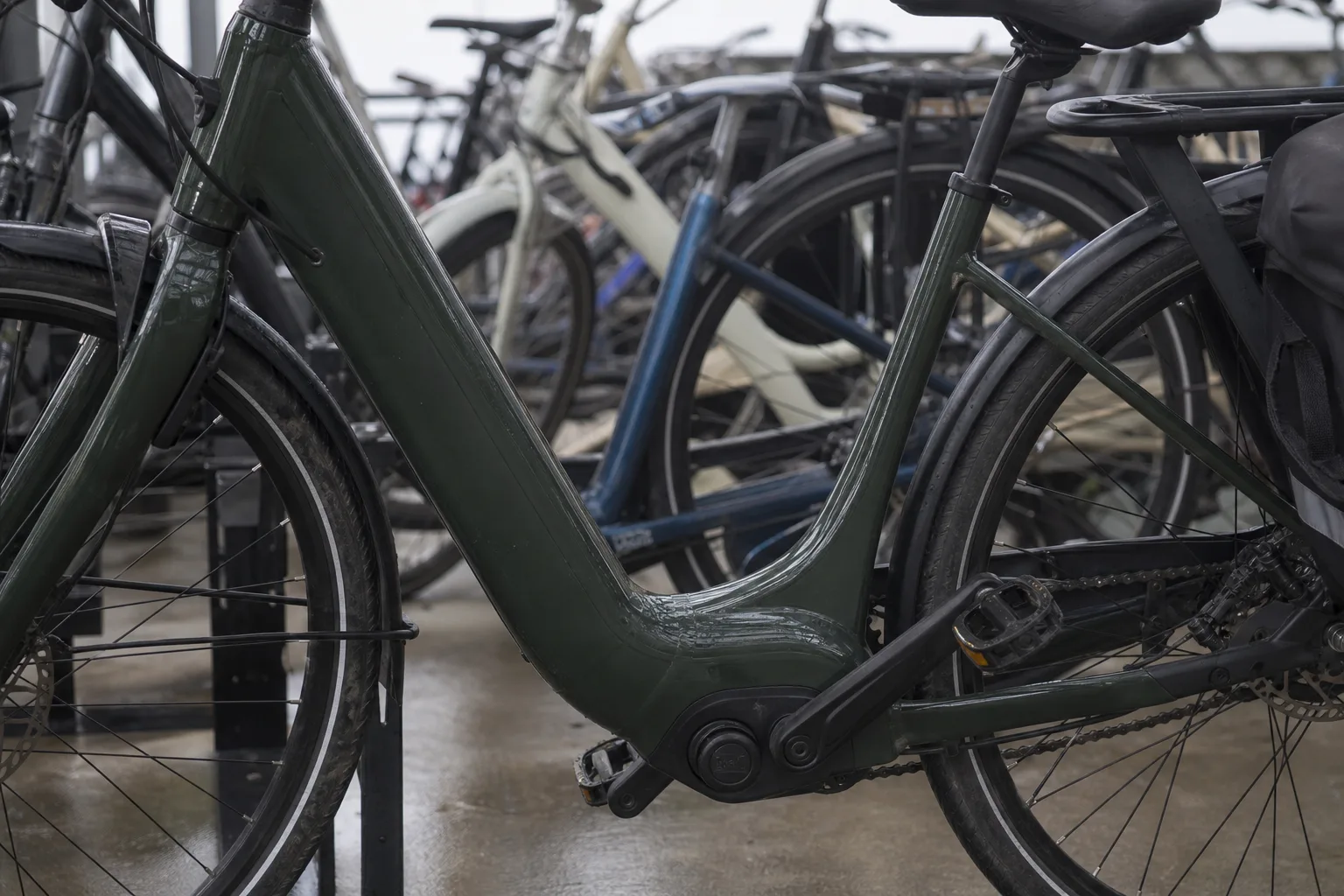
Manufacturer weights rarely include a rack, fenders, lock and cargo, which together can add fifteen pounds or more. Judge mounting and stopping by the weight the bike will actually be when you use it.
A pedal-assist bike built for errands weighs somewhere between fifty and seventy pounds with a rack, fenders and a lock aboard, and every one of those pounds shows up at the two moments that matter most: swinging a leg over at the curb, and holding the thing upright at a red light on a grade. A frame that felt fine rolling across a flat showroom floor can feel unmanageable pointed uphill with groceries on the back. The measurements that predict this are not the ones printed largest in the catalog, and most of them can be checked with a tape measure and ten minutes.
Standover on a diamond frame, step-over on a step-through
On a conventional diamond frame the number to check is standover height, the distance from the ground to the top tube at the point where you straddle it, and the useful test is whether you clear it in the shoes you actually wear with an inch or two spare. On a step-through the equivalent number is the lowest point of the frame's opening, often eighteen to twenty-four inches off the ground rather than thirty-odd, and the difference is not merely comfort. It is the difference between lifting a leg to hip height beside a loaded bike and stepping through at knee height while both hands stay on the bars.
The mid-step or trapeze frame sits between the two, with a top tube sloping steeply down toward the seat tube, and it is worth measuring rather than assuming, because a mid-step's low point often lands closer to a diamond frame than to a true step-through. Compare the two you are considering at the same spot on the frame, not at whatever point each manufacturer chose to quote. A careful reader also checks how far forward that low point sits, since a step-through opening crowded by a battery or a wide down tube gives back some of what it promised.
Saddle height and the flat-foot compromise
Pedaling efficiency wants a saddle high enough that your knee stays slightly bent at the bottom of the stroke, and stability at a stop wants a saddle low enough to plant a foot flat. On a light bike you can favor the first and tiptoe at lights without consequence. On a sixty-pound bike stopped nose-up on an eight percent grade, the foot that touches down is carrying the bike's whole tipping moment, and a toe is not enough. The usual resolution is a saddle set for pedaling with a frame low enough that you slide forward off the nose at a stop, which is a habit worth practicing rather than a compromise in the geometry.
Two numbers govern whether that is possible: the minimum saddle height the frame allows with the post at its insertion line, and the distance from the saddle nose down to the top tube or frame opening. Measure your inseam in shoes, subtract, and compare it against both. The Consumer Product Safety Commission oversees bicycle safety requirements in the United States, and standover clearance has long been part of how fit is discussed, but the tape measure in your own hand answers the question faster than any spec sheet.
Reach and bar height when the bike is standing still
Reach, the horizontal distance from the saddle to the handlebars, decides how much of your weight sits over the front wheel, and on a heavy commuter bike a shorter reach with taller bars puts you more upright, more able to look over your shoulder, and better placed to catch the bike if it leans. An upright rider on a steep street can hold a stopped bike with one hand and one foot. A stretched-out rider on the same bike is fighting the frame's own weight from a poor angle. Adjustable stems and riser bars change this cheaply after purchase, which is worth knowing before you reject a frame you otherwise like.
What the label on the frame actually tells you
A frame marked as a women's model usually means a step-through opening, sometimes a shorter reach, occasionally a narrower bar and a different saddle, and it reliably means nothing about the numbers that decide your fit. Plenty of men buy step-throughs for the same reason plenty of riders with long legs buy the unisex frame: the opening height and the reach happened to suit them. Read the geometry chart instead of the label, and if a chart is not published, measure the demo bike on the floor.
Bring a tape measure, wear the shoes, and ask to try mounting the bike on the steepest piece of pavement near the shop with something heavy on the rack. Ten minutes there tells you more than a week of reading.
Where the opening is lowest
On a step-through frame, the lowest point of the opening is the number that matters, and it is often eighteen to twenty-four inches from the ground. Check where that low point sits fore and aft, because a battery or a fat down tube can crowd it.
Mid-step frames vary widely
A mid-step or trapeze frame can measure close to a diamond frame or close to a step-through depending on how steeply its top tube drops. Measure it yourself rather than trusting the category name.
Inseam in shoes
Measure your inseam wearing the shoes you commute in, since a thick sole changes the figure by half an inch or more. Compare that number against both standover and minimum saddle height.